
Resources
 This feature requires you to be logged in.
Year 7 and 8 - English
Topic: Multiculturalism

 Document
Year 7 and 8 - Culture and multiculturalism lesson
This lesson examines the ethical challenges of bystander behaviour and the importance of speaking out against injustice.
 WORD
WORD
 Document
Year 7 and 8 - Nationality and citizenship lesson
In this lesson, students explore the meaning and significance of citizenship pledges and how they reflect national values, with a focus on multiculturalism and inclusivity.
 Document
Year 7 and 8 - Aboriginal and Torres Strait Islander Peoples as the First Peoples of Australia lesson
This lesson sequence helps students understand how racism is described and challenged through different texts, focusing on how language and literary devices express strong emotions and ideas.
 Document
Year 7 and 8 - Australians from Culturally and Linguistically Diverse (CaLD) backgrounds lesson
This lesson explores the unique nature of Australian English as a hybridised language shaped by centuries of migration, Indigenous heritage, and global influences.
 Document
Year 7 and 8 - Diaspora and third culture generations: Culture and multiculturalism lesson
The following sequence of activities is based on an autobiographical text in which the author recounts the importance of his friendship with an Australian classmate and its role in his emerging identity.
 Document
Year 7 and 8 - Australian identities: Diversity and stereotype lesson
This lesson sequence encourages students to recognise the use of stereotypes in tourism advertising over time, fostering media literacy and cultural awareness.
 Document
Year 7 and 8 - Australian identity: Challenging perceptions – a sense of belonging and cultural identity lesson
In this lesson, students explore and express their personal and cultural identities - as well as their sense of belonging - by crafting and performing “I Come From” poems.
 Document
Year 7 and 8 - Complexity of identity and international diversity lesson
In this lesson sequence, students explore how migration and international diversity have shaped Australia by engaging with personal, community, and historical migration stories.
 Document
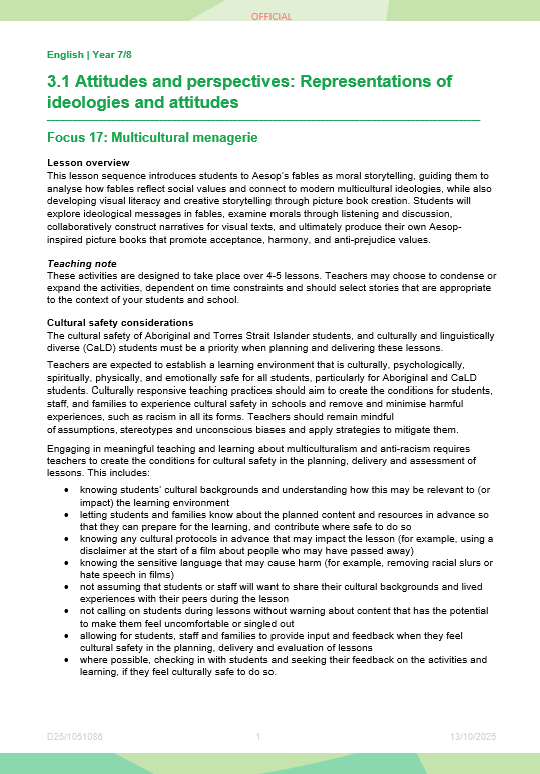
Year 7 and 8 - Attitudes and perspectives: Representations of ideologies and attitudes lesson
This lesson sequence introduces students to Aesop’s fables as moral storytelling, guiding them to analyse how fables reflect social values and connect to modern multicultural ideologies.
 Document
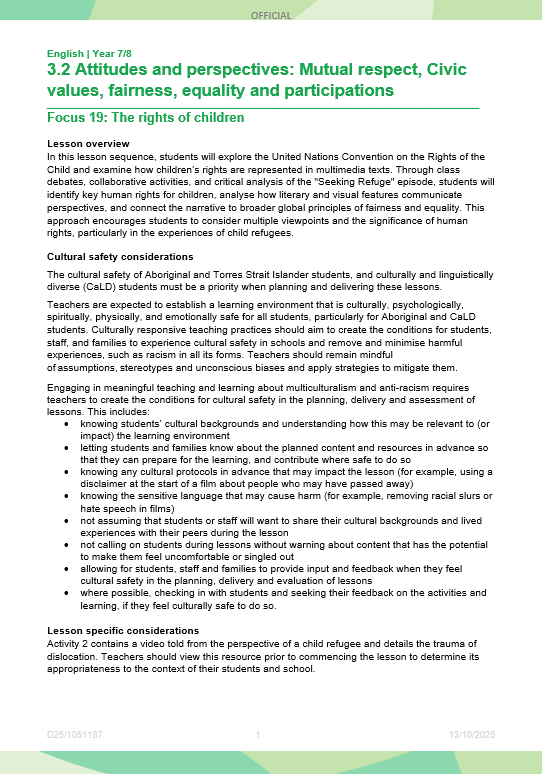
Year 7 and 8 - Attitudes and perspectives: Mutual respect, Civic values, fairness, equality and participations lesson
In this lesson sequence, students will explore the United Nations Convention on the Rights of the Child and examine how children’s rights are represented in multimedia texts.